



Share this post


I remember in my early years of leadership at Wooga, when I was leading the Diamond Dash LiveOps team tasked with growing game revenues quickly. The team already existed before me, and I had a big conflict with one of the backend engineers. To the point that it was him or that it was me, who stays.
I couldn’t tolerate his misbehavior anymore. He showed up late, didn’t fully complete sprints, found excuses for unfinished work, and rarely contributed beyond the bare minimum. Essentially, he just did his tasks and checked out.
At the time, this frustrated me deeply. I needed him to step up and be proactive. Instead, his behavior was pulling the team back.
One day, I confronted him directly and told him why his behavior was bad and why it hurt the team. I lectured him, expecting that this would trigger change. Instead, I got even more justifications, defensiveness, and dismissive behavior. Nothing changed. Eventually, we had to part ways.
Looking back, I can see how those conversations went wrong. I had approached him like a parent scolding a child, and he reacted exactly like that — rebellious, resistant, and checked out.
We weren’t relating as two professional adults anymore. We were two immature people (=children) having an ego fight.

It is until I developed my coaching techniques that I could make sense of it. We were conversing in different ego states. There was no way we could align, until we got awareness of our ego states first.
Transactional Analysis Theory
Welcome to the Transactional … what??
Transactional Analysis (TA) was developed by Canadian psychiatrist Eric Berne in the mid-1950s, emerging from his background in psychoanalysis. Berne aimed to create a more understandable and accessible theory of personality and communication, demystifying complex psychoanalytic concepts for both therapists and clients. His work focuses on ego states (Parent, Adult, Child), social transactions, life scripts, and games to analyze behavior and facilitate personal growth and improved relationships.
TA has been largely used in coaching too, and I believe has its place in the future of leadership oriented to coaching instead of traditional “management” building authority on parent-child dynamics.
The Three Ego States
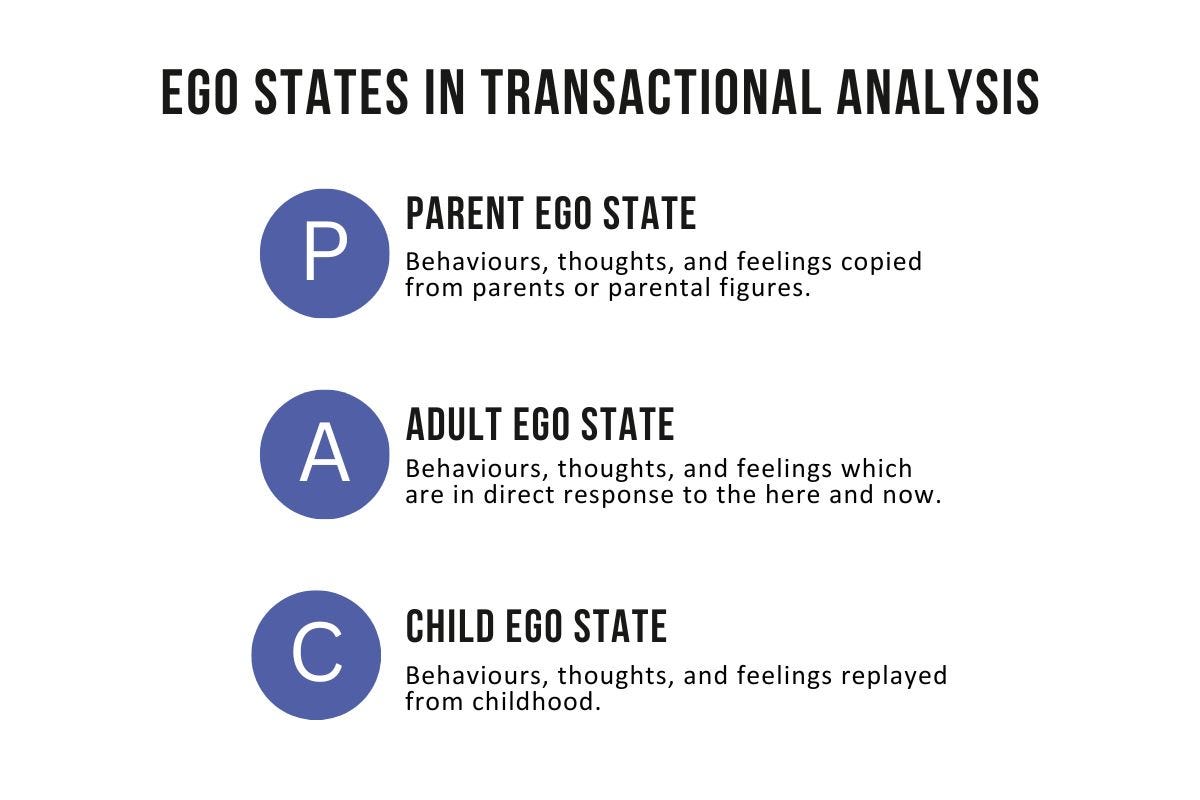
Every time we interact with someone, anyone, we operate from one of three ego states:
Child State > The Employee
- Traits: Rebellious, resistant, uncooperative, playful, or dismissive.
Parent State > The “Boss”
- Traits: Judgmental, corrective, authoritative, moralizing.
- Focus: Right vs. wrong.
Adult State > The Coach, Leader or Partner
- Traits: Objective, fact-driven, pragmatic.
- Focus: Problem-solving, collaboration, and outcomes.
The problem arises when we unconsciously slip into Parent-to-Child dynamics: a boss judging, and an employee rebelling. In these moments, both sides stop seeing each other as equals.
Worse, is when one party is in the Parent-child dynamic while the other party is trying to approach the conversation as Adult-adult. There is a dissonance of expectations (called Crossed Transactions), and the conflict remains stale until both parties can meet at the same level of Transactions.
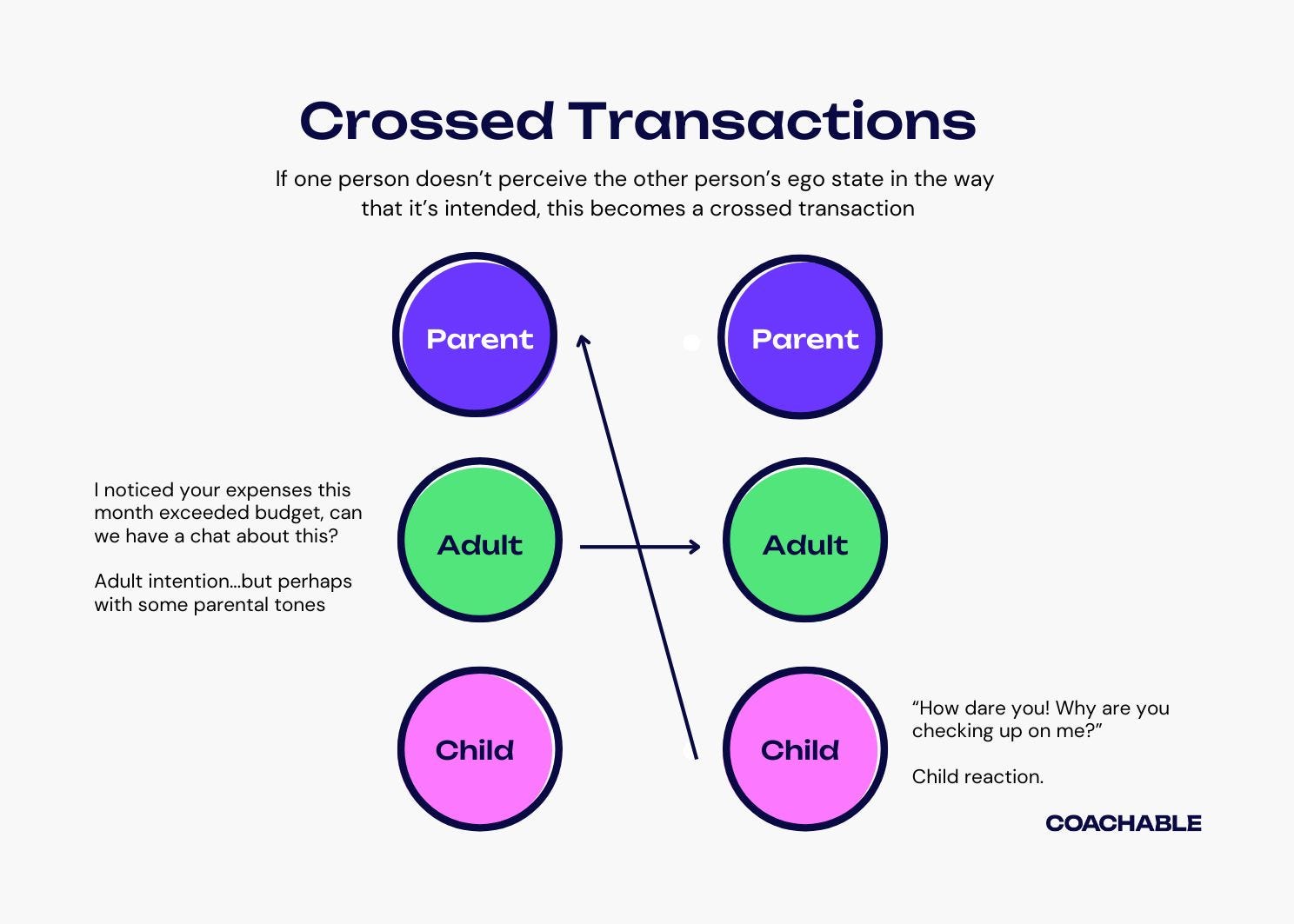
The transactional level we want to aim for, whether in leadership, teams, or even romantic relationships are Adult-to-Adult.
How To Practice Adult-to-Adult Conversations
- Self-awareness: check your own state.
Ask yourself: Am I speaking from judgment (Parent), from rebellion (Child), or from objectivity (Adult)? - Empathy: notice the other person’s state.
If they’re defensive or rebellious, they may be in Child mode. If they’re judgmental, they may be in Parent mode. - Ownership: be the change you want to see.
Bring yourself first back to the Adult state sticking to facts, outcomes, and shared accountability. - Collaboration: Invite the other person up.
Model the Adult state and encourage the other one to meet you there. This shifts the conversation onto equal ground.
When you catch yourself in a Parent or Child ego states, don’t feel too bad about it and remember that you are just replaying old scripts from your culture or childhood.
💡Reflection Coaching Questions
Here are a few reflection questions you can practice to improve your self awareness, and self-regulate when you’re in a child or parent ego state:
- In conflict, which state do you naturally default to?
- What are the triggers that push you into Parent or Child mode?
- When you catch yourself, what practice will help you return to Adult mode?
- How will you invite the other person into an Adult-to-Adult conversation with you when they are in Parent or Child ego state?
We all move between Parent, Child, and Adult states daily. The key isn’t to stay permanently in Adult mode (that’s unrealistic) but to develop the awareness to catch yourself, reset, and choose to return back to an adult state.
It is a lifetime practice. But don’t worry, you are not alone ;)


.jpeg)


